Editor’s Note: This review covers the pre-release demo of Good Children Say Grace. According to the developers, the October 16 release and updated demo feature substantial narrative revisions, improvements, and additional content.
What happens when you’re surrounded by people, but nobody seems willing to listen? Apparently, you end up in a stairwell full of egg-headed strangers questioning your own reality.
QUICK SNAPSHOT
- Developer: Denis Morozov and Milha Vek
- Publisher: Denis Morozov
- Genre: Absurdist Psychological Horror, Adventure, Interactive Fiction
- Platform: PC (Steam)
- Demo Length: Multiple short branching routes; completion time varies
- Demo Available: Yes, free on Steam
- Full Release: October 16, 2026 (announced)
- Wishlist: Good Children Say Grace on Steam
KEY TAKEAWAYS
- Unsettling storytelling: Family dysfunction, loneliness, and grief establish an uncomfortable atmosphere from the opening.
- Meaningful exploration: Dialogue choices and movement determine which narrative routes you encounter.
- Distinct visual presentation: Human characters, animal-like figures, and egg-headed inhabitants create an unusual world.
- Dark absurdist humor: Bizarre encounters explore addiction, exploitation, and emotional neglect.
- Demo verdict: An intriguing psychological horror experience that encourages experimentation, although its fragmented storytelling won’t appeal to everyone.
FIRST IMPRESSIONS
With a title like Good Children Say Grace demo, I wasn’t expecting to become confused about an entire family’s history within the first few minutes.
The prologue opened with a mother describing how her family appeared happy for seven years. Apparently, that happiness was mostly for show. Behind closed doors, the neighbors heard arguments involving the father’s infidelity.
The mother described abandonment, while the conversation turned toward whether the father had ever genuinely loved his family. His response involved an intimate relationship with the mother’s brother.
Meanwhile, Martin, our protagonist, appeared increasingly distressed, pleading with his mother to stop.
I also noticed an uncomfortable visual involving a female character positioned over Martin. Combined with his earlier remark about his mother sometimes entering without vodka, the whole situation raised questions.
Was I witnessing a memory? A distorted account of family trauma? Something entirely different?
I genuinely couldn’t tell. However, I wasn’t confused in a bad way. The presentation made me curious enough to continue.
After the prologue ended with the father’s death, the narrator offered three emotional options: melancholy, deeper melancholy, or very deep melancholy.
Naturally, I picked regular melancholy. Apparently, I hadn’t suffered enough yet.
Martin then questioned why someone couldn’t love him. The narrator suggested that she loved him only as much as she loved herself, which wasn’t particularly reassuring.
And that was just the introduction.
THE GAMEPLAY LOOP
The Good Children Say Grace gameplay revolves around exploration, conversations, and choosing which interactions to pursue.
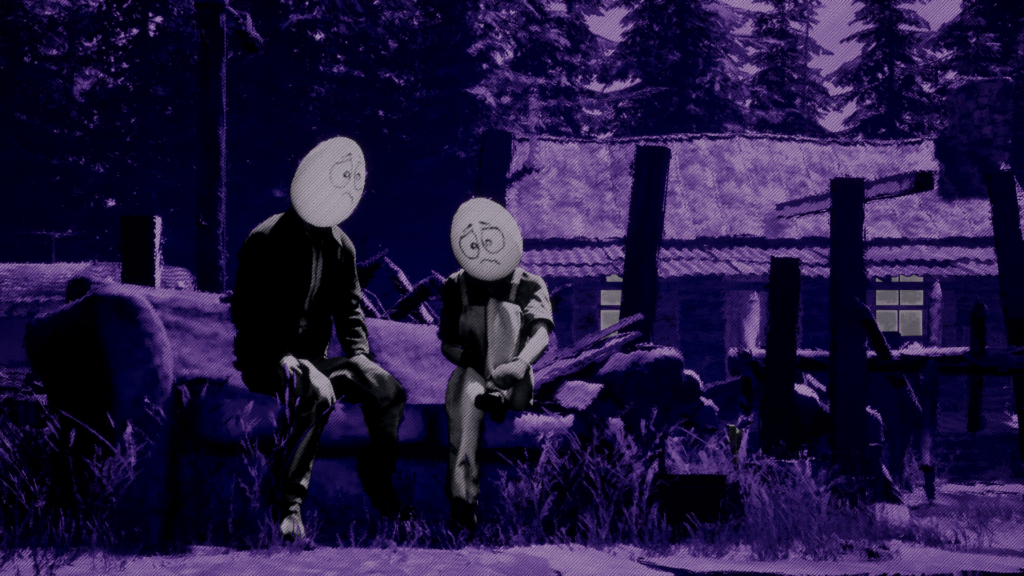
I began in a stairwell populated by bizarre egg-headed people. Some stood along the stairs wearing different expressions, while a girl named Daria sat downstairs.
I quickly noticed a visual pattern where red objects generally indicated something interactive.
One red double door caught my attention immediately. Martin seemed reluctant to return home, which made me wonder what waited behind it.
Rather than commit to a direction, I explored.
The pause menu displayed numerous possible narrative routes, giving me an idea of how much I might miss during a single playthrough.
This became one of the demo’s more interesting mechanics. I could restart, choose another direction, and discover completely different encounters.
The developer describes this as a dialogue- and movement-based decision system. From what I experienced, that description fits.
Daria, the Television, and Nobody Listening
My first conversation with Daria made me question what kind of reality Martin inhabited.
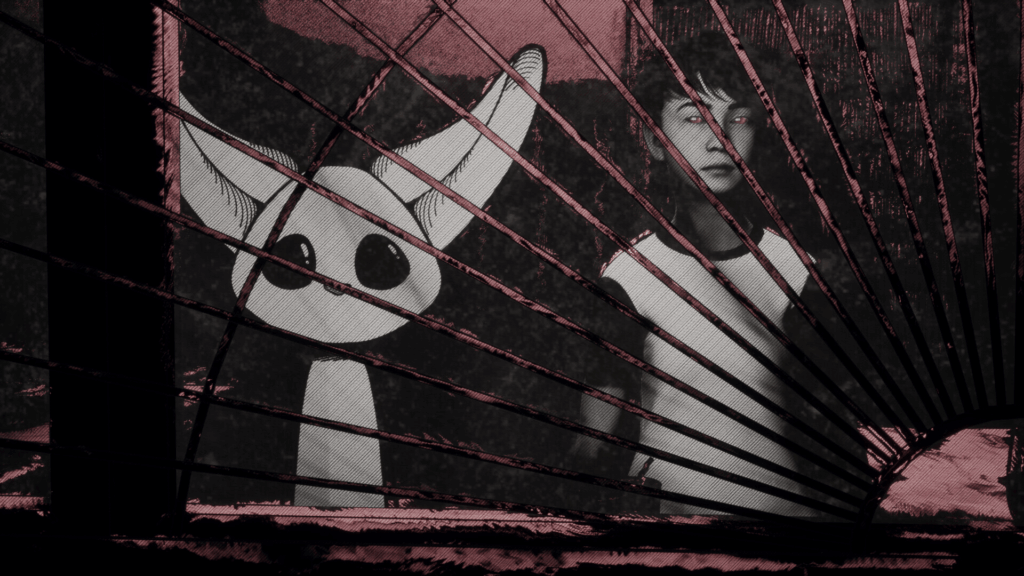
Martin, resembling a strange bunny-eared animal, sat beside a girl who looked distinctly human. The contrast was immediately noticeable.
The narrator described Martin as Daria’s human television, something to distract her from the screaming inside her head.
That’s quite a description for someone’s company. The narrator’s calm delivery made these otherwise disturbing statements feel strangely ordinary.
When I asked Daria why she left, her responses were evasive. She floated possibilities involving kidnapping or building a boat to escape, then questioned which explanation would allow Martin to sleep again.
Was she real? Was Martin imagining their relationship? Was the narrator trustworthy? I didn’t want to jump to conclusions.
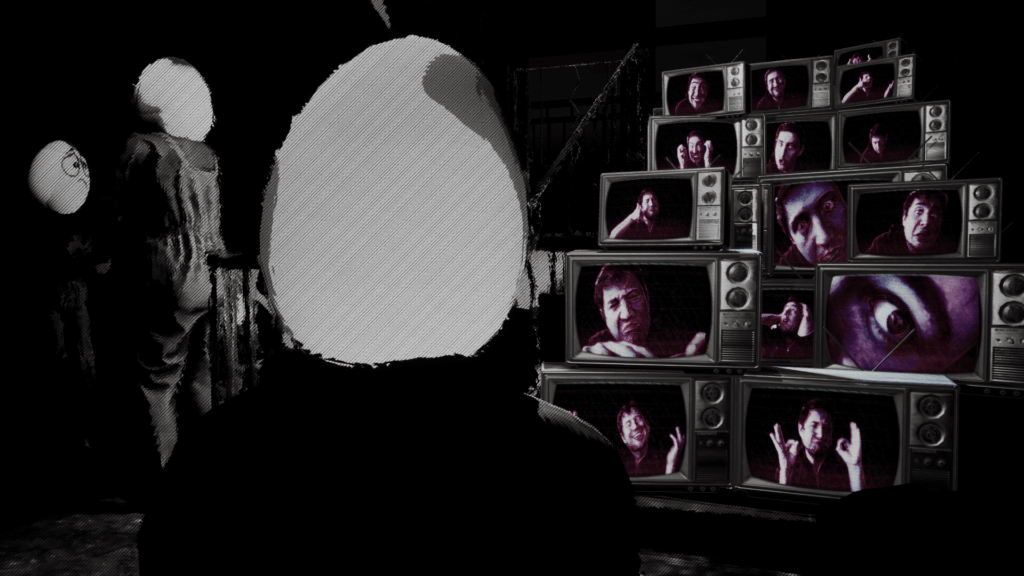
Upstairs, I discovered another peculiar scene of egg-headed people gathered around a television, seemingly worshipping it.
A human-looking presenter eventually awakened and began addressing the audience with contempt.
He described people as disposable components of a larger system, then mocked the idea that good children would ever find themselves in such miserable circumstances.
Then came the uncomfortable part. The presenter, or TV MAN, reported on a local boy claiming aliens had kidnapped his girlfriend.
That sounded suspiciously familiar. Martin pleaded for someone to believe him, but the presenter dismissed his concerns and told him to move on.
After several interactions, the presenter refused to continue speaking.
Martin’s response was simple, who else was he supposed to talk to? I don’t have a full understanding of everything but this says a lot about the world.
THE ATMOSPHERE

The atmosphere is where this psychological horror indie game becomes particularly interesting.
The stairwell felt bleak and sterile, yet its inhabitants behaved as though nothing was unusual.
The egg-headed crowds weren’t actively attacking me. They simply existed, watching, waiting, or participating in strange routines.
Some appeared to worship a television. Others gathered around a glass enclosure containing three human performers.
Inside, Marina and Pavel sat on chairs while Sergei lay beneath an overturned chair.
Apparently, this bizarre display was a crowdfunding effort.
Marina worried about having to work in the mines if the arrangement failed, while Sergei sounded completely exhausted.
Martin asked what was happening. Before I received a satisfactory explanation, that route ended.
It’s an absurd scene, but the underlying references to poverty, labor, and exploitation made it less ridiculous than it initially appeared.
The game frequently blurs that distinction, as something looks funny until you consider what the characters are actually saying.
SOUND DESIGN

One element I appreciated was the narrator’s delivery. It was calm and almost reassuring.
That created an distinct contrast with the bleak environments and emotionally disturbing dialogue.
I found the voice informative, but its composure made certain statements more unsettling.
The game also features Japanese voice acting by Kaori Shimizu, known for Serial Experiments Lain, with vocals by Nami Nakagawa and voice direction by Norihiko Hibino.
It’s an impressive collection of talent for an independent production.
Still, my strongest audio impression from the demo was how naturally disturbing information was delivered, rather than any particular musical sequence.
Sometimes a calm explanation makes an uncomfortable situation even worse.
WHEN IT CLICKS

I restarted the demo several times, and this was when its branching narrative horror game structure started clicking.
During one route, I invited Daria outside and eventually chose to run away with her.
Martin discussed the environment, including food, mud, and rain. Then Daria questioned whether he realized he was talking to himself.
Martin asked what he was supposed to do alone. Well, that certainly didn’t help my earlier suspicions.
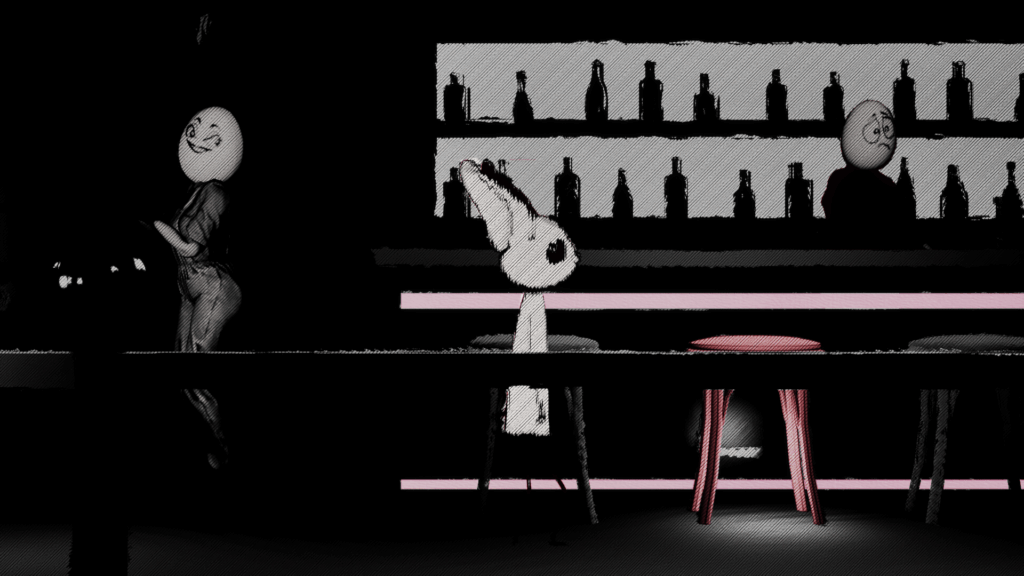
Another route led me into a lounge and bar.
The egg-headed bartender offered to begin my drinking journey with a complimentary drink. He explained that whether people arrived through sadness or addiction, the establishment would eventually profit.
That’s one way to describe customer retention. Upstairs, an egg-headed pole dancer performed the same movements repeatedly.
Martin wondered whether this was the striptease the television presenter had mentioned, prompting the dancer to remind him that pole dancing was a sport.
She encouraged him to watch.
After reluctantly agreeing, Martin questioned when the entertainment would actually become enjoyable. Her answer? Around the third drink.
I couldn’t help noticing how neatly the encounter connected back to the bartender’s earlier comments.
Finally, I experimented with a red mailbox. It was empty, and Martin wondered whether he should give it something.
I offered a smile. The mailbox responded with disgust… lovely. So, I tried sending a heart instead, which appeared in the mailbox. After being instructed to close my eyes, I found myself back in the stairwell.
Even an ordinary mailbox somehow became another uncomfortable social interaction.
WHAT DIDN’T WORK
As much as I enjoyed exploring, the demo isn’t without rough edges.
The storytelling can become difficult to follow. Characters introduce disturbing information without much context, and several encounters end before meaningful explanations emerge.
I personally found this intriguing, but players who prefer more immediate narrative clarity may struggle.
There was also a technical issue during my bar exploration. After transitioning between areas, Martin temporarily disappeared from view.
Fortunately, moving upstairs and returning downstairs restored him. It wasn’t game-breaking, but it interrupted the experience.
I also would’ve appreciated a little more resolution within certain demo branches. Some sequences ended just as I began understanding their premise.
Of course, the demo is only a sample of the larger demo and then story, so I can’t judge whether the full experience eventually ties everything together.
DEMO VERDICT
The Good Children Say Grace demo left me with more questions than answers.
I’m still unsure what happened during parts of the prologue, what Daria’s relationship with Martin truly represents, or how much of the world should be interpreted literally.
But I wanted to find out.
Its strongest feature is the persistent discomfort of inhabiting a world where everybody seems to have something to say, yet nobody wants to listen.
The television presenter dismisses Martin. The bartender minimizes his grief. Daria complicates his understanding of reality. Even the mailbox has an attitude.
Underneath the absurdity, I noticed recurring themes of loneliness, emotional neglect, exploitation, and the desperate need for connection.
For me, the most interesting question was whether anyone in this world would ever take Martin seriously.
WATCH THE FULL PLAYTHROUGH
Want to explore the strange world of Martin and its egg-headed inhabitants yourself?
Play the Good Children Say Grace Demo and Wishlist on Steam
Developed by Denis Morozov and Milha Vek, Good Children Say Grace is scheduled to release October 16, 2026.
Craving more creepy absurdist horrors, check out EXCISA or the if you want more psychological tension, take a look at PROCEDURE ZERO here.
If you enjoy indie horror breakdowns like this, follow Gravenox Horror Gaming, and trust me to explore horror so you don’t have to.

Nero is a writer and lore researcher known for reviewing games on Steam. With years of experience playing horror games, uncovering hidden narrative patterns across indie and AAA titles, and publishing museum catalogs on ancient objects, he blends commentary with psychological horror theory. When he’s not unraveling storylines, he’s enjoying rock music, drawing, working in analytics or obviously playing video games. Check out his latest post to explore the furtive patterns hidden in game lore.