
Terms
- Fear: An adaptive emotional response that emerges when perceived threats or disruptions to predictive stability increase.
- Adaptation: A behavioral, cognitive, or emotional adjustment developed to reduce fear or improve survival under changing conditions.
- Predictive Stability: The degree to which an individual’s internal models successfully anticipate and navigate environmental conditions.
- Predictive Destabilization: A disruption of expected patterns that weakens confidence in existing predictions and increases uncertainty.
- Flexible Identity: A self-concept that allows behaviors, beliefs, and adaptive strategies to be revised in response to new information.
- Protective Identity: A self-concept in which adaptive strategies become integrated into identity and are maintained to preserve psychological safety.
- Renewal: The process of reevaluating and updating beliefs, behaviors, or identity structures that no longer serve present conditions.
- Revitalization: The restoration of flexibility and psychological openness following the revision of rigid adaptations.
- Antifragility: The capacity of a system or individual to benefit or grow through manageable stress or uncertainty.
Fear as an Adaptive Mechanism: How Survival Strategies become Identity

Certain experiences influence us to respond with various emotions. This comes from a stimulus, creating a stimulus response. Nature had given us several patterns for emotional response. One of those is fear.
Fear is often constrained to a response to danger. From an evolutionary perspective, fear seems to function as a primary emotional system designed to detect threats and promote survival behaviors (Panksepp, 2004). Yet, fear may also function as an adaptive signal when predictive stability weakens and the perceived threat to survival, identity, support, and safety or meaning arises,
To lessen fear, humans develop adaptive strategies.
When those patterns repeatedly appear, they can become rigid, which eventually evolves from transitory survival response into an enduring piece of identity
So, the question becomes: how does a survival strategy become a personality??
I. The Problem of Fear

Most think of fear as just the flight-fight-freeze-or-fawn response. Well, it’s true but a simplified suggestion of a complex mental process.
Throughout life, we develop many fears, from things we can see to things we can’t. As a child, I remember classmates often talking about the Goatman in the woods or Bloody Mary in the mirror. Over time, though, most childhood fears either fade or make more sense. What was once unknown became familiar, predictable, and easier to handle.
Sometimes, trauma speeds up this process because it’s necessary for survival.
When I was a child, I went through a major event. At first, my body froze while my mind tried to make sense of what was happening. As it became harder to predict what would come next, I started to feel confused, anxious, scared, and uncomfortable. When those feelings got strong enough, I shifted into survival mode.
Survival became freezing, rapid categorization, dissociation, and hypervigilance until the event eventually ended.
Afterward, my body started to relax, but not all the way. I stayed more alert than usual, even as the danger faded. My thoughts calmed down, and I slowly felt more in control. As I processed what happened, things made more sense again. What first broke my sense of stability eventually turned into a sharper awareness meant to help me avoid future shocks.
Like a system, my mind and body received a novel input, attempted interpretation, and applied that interpretation against an internal predictive model of stability. When prediction weakened, emotional and physiological responses intensified to preserve survival and restore coherence.
What I find interesting is that this process isn’t just about trauma or one person’s mind. The same pattern shows up in biology, societies, and ecosystems. Stability helps things hold together, but too much rigidity can hide problems underneath.
My point is that this concept, this emotion of fear, may function as more than a simple survival response. I believe there is a hidden process, and fear may instead operate as a natural signal of destabilization within systems themselves.
This then raises several questions. Why does fear persist after the danger is gone? Why do people continue acting defensibly long after a threat ends? Why do some fears reshape identity.
II. Predictive Mind and Psychological System

Modern neuroscience increasingly models the brain as a predictive system attempting to minimize uncertainty and maintain congruent internal models of reality (Parr et al., 2022). Within predictive processing framework, perception has several uses. It serves as a passive receptor of sensory information. Additionally, the brain continuously generates predictions about the environment and updates those predictions when new information differs from expectation (Clark, 2013). Other researchers propose that emotions surface through predictive processing, where the brain actively constructs emotional experiences based on bodily sensations and surrounding information relative to the prior experience (Barrett, 2017).
If we consider these assertions backed by empirical evidence, then fear is a signal of predictive destabilization. Fear would then emerge when prediction stability weakens and the possibility of harm or systemic disruption rises.
Foundations of Fear
Neural research highlights that fear responses surfaces from specialized circuits involving the amygdala and interconnected pathways meant to process threats and coordinate survival responses (J. E. LeDoux, 1996; LeDoux Joseph E., 2009).
Fear may be a negative emotion or a reflexive reaction to external stimuli. Affective neuroscience suggests fear acts as one of several primary emotional systems that evolved to support survival by increasing vigilance and avoiding behaviors in response to perceived threats (Panksepp, 2004). However, contemporary neuroscience distinguishes between automatic fear responses coordinated by survival wiring and the subjective experience of feeling fear, suggesting that what we call “fear” is a reflex and complex neural processing (J. LeDoux, 2012).
Likewise, current theories of emotion suggest that emotional experiences are actively constructed through predictive processes that pull in bodily state, prior knowledge, and environmental information (Barrett, 2017). In this framework, fear may signal an adaptive response to perceived threats against:
- Bodily integrity
- Identity continuity
- Environmental predictability
- Social belonging
- Existential coherence
So, fear may function as a system-integrity threat detection mechanism.
Why Prediction Exists?
The brain is a flexible structure but cannot react to every event from scratch. Predictions allow organisms to anticipate likely outcomes, conserve energy, avoid potential dangers, and respond more quickly to threats or opportunities.
Predictive processing theories suggest that perception and action operate in junction within this process. Organisms clearly predict their environments; they further act upon the world in ways that help confirm or refine those predictions (Clark, 2013).
Fear reallocates cognitive and physiological resources to threat predictions. Beyond simple reactivity, emotions like fear actively guide decision-making by integrating bodily states and expectations about the environment, helping organisms take adaptive actions (Damasio, 1994, 1999). When uncertainty rises beyond manageable thresholds, attention narrows, vigilance increases, memory encoding sharpens around salient details, and behavior becomes oriented toward reducing uncertainty and reestablishing safety.
Thus, fear functions as an adaptive signal indicating that existing mental schemas may no longer adequately account for current conditions. This process can be conceptualized through the following model:
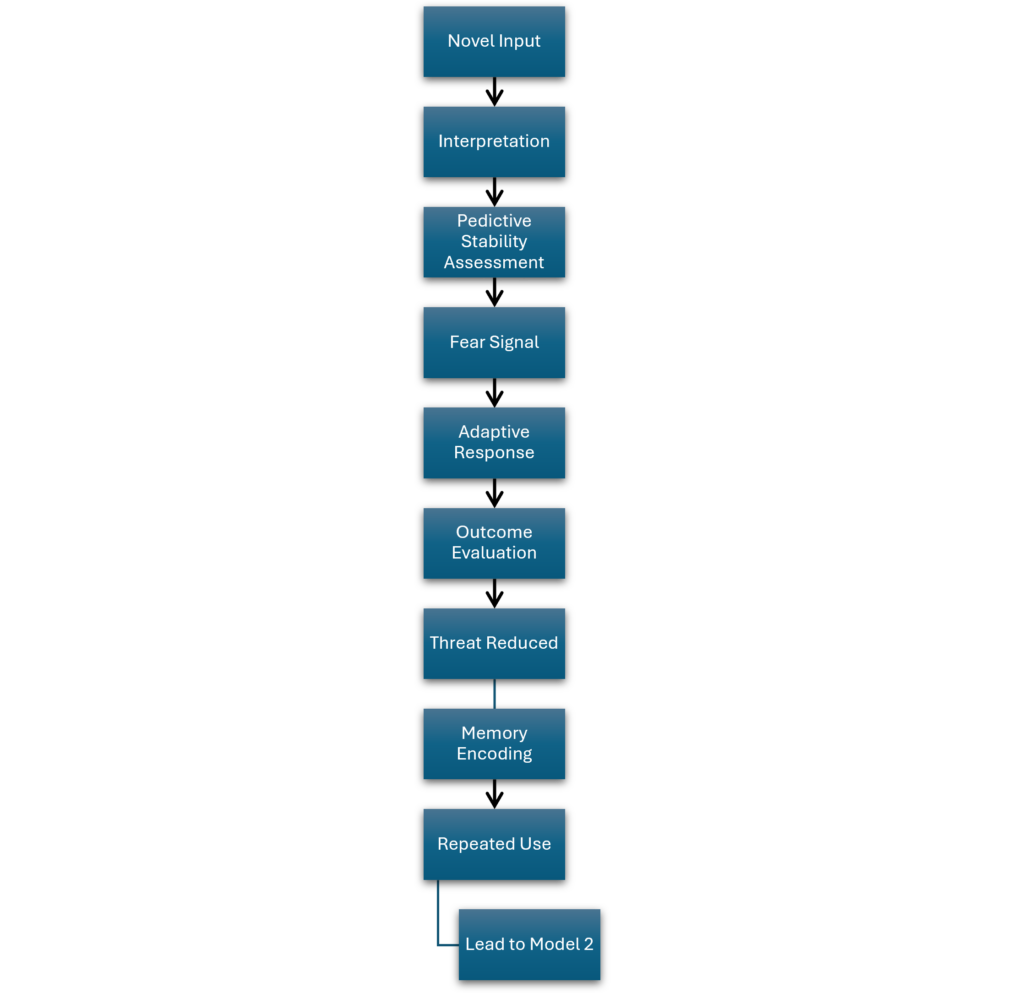
Based on this information, if fear helps organisms adapt to perceived threats, a question emerges: why do some fear-driven behaviors persist long after the original threat has physically disappeared? Model 2 proposes that behaviors which successfully reduce fear get reinforced and gradually stabilize habits.

Here, Model 2 explains behavioral persistence, but they don’t fully explain identity. Some habits remain flexible tools, whereas others become integrated into a person’s self-concept. Model 3 explores how repeated reinforcement may transform adaptive behaviors into identity structures.

Not all adaptations become maladaptive. Some remain flexible tools that can be updated in response to new information, while others become protective identity structures that resist change even when the original threat no longer exists.
III. Fear Creates Adaptation

The emotion of fear rarely remains an isolated experience. Survival responses initially emerge to increase the likelihood of protection during threatening circumstances. Over time, however, reactions that were once temporary may become reinforced through repeated activation (Levine, 1997). When fear repeatedly emerges in response to specific threats, people often develop strategies meant to reduce uncertainty, maintain safety, or preserve social stability. According to Damasio 1994, emotions guide these adaptive behaviors, ensuring choices enhance survival and social cohesion. Such strategies may initially function as adaptive responses to specific conditions, but repeated success can reinforce their continued use.
Fear of Rejection
Being rejected can have a significant psychological impact. Humans evolved within cooperative social groups where access to protection, resources, and support often depended on preserving social bonds. As a result, social rejection may be experienced as a threat to belonging and relational stability. When individuals perceive rejection or anticipate it, fear can emerge as a signal that social safety is at risk.
To reduce this fear, people may develop adaptive strategies such as people-pleasing, masking, excessive agreeableness, or mirroring. Attachment theories propose that people often develop behaviors aimed at preserving acceptance and relational security, particularly when social connection is perceived as undetermined or threatened (Bowlby, 1969). Since self-concept develops in part through social interaction and feedback, repeatedly successful adaptations may become incorporated into a person’s understanding of who they are (Mead & Mind, 1934). In that way, these behaviors can increase acceptance, reduce conflict, and sustain social connection. They may restore a sense of safety in the short term. However, repeated reliance on these strategies may gradually reinforce them, increasing the chance that they become habitual responses to perceived social threat.
Fear of Failure
When faced with failure, humans don’t so much fear the outcome itself but the psychological consequences that may follow. Failure may evoke shame, challenge perceptions of incompetent, threaten self-efficacy, and change how individuals believe they are seen. There may also be fear of rejection or social disapproval, which could signal loss of connection, support, or belonging.
There are several ways we reduce this fear. Humans could develop an adaptive strategy toward becoming a perfectionist. Research on perfectionism suggests that exceptionally high standards often emerge along concerns about mistakes, criticism, and social evaluation, making perfectionism a potential strategy for reducing perceived threats associated with failure (Hewitt & Flett, 1991). Other adaptations could be overachieving or excessive preparation. These adaptive strategies help mitigate the smallest error, reduce criticism, and increase success. Yet, if these behaviors continue, they could steadily reinforce automatic responses.
Fear of Emotional Harm
Emotional harm may arise from chronic stress, trauma, emotional abuse, betrayal, or repeated experiences of rejection. Such experiences may alter an individual’s perception of safety, trust, and relationships, contributing to how future threats are interpreted (Herman, 1992). In some cases, prolonged exposure to emotional harm may also influence physiological stress systems and threat processing networks in the brain.
Humans process strong motivational systems aimed at safety, threat avoidance, and attachment. The brain may build psychological walls to reduce experiencing this pain from emotional harm again, contributing to persistent states of vigilance and defensive responding even after the original source of harm has ended (Van der Kolk & Viking Press publisher., 2014).
Suppressing, avoiding, and emotionally withdrawing can reduce immediate distress, lower perceived vulnerability, and create a temporary sense of safety. Emotion regulation studies found that suppression can temporarily reduce emotional expression and perceived vulnerability, making it an effective short-term strategy for managing stress (Gross, 1998). However, repeated reliance on these strategies may contribute to self-isolation, hypervigilance, emotional restriction, or difficulty forming secure connections.
Fear of Unpredictability
Unpredictability may evoke a fear of the unknown in people. Human brains continuously generate predictions to anticipate threats and opportunities. When events become too difficult to predict, uncertainty increases and confidence in those predictions weakens.
In absence of sufficient information, individuals may attempt to reduce uncertainty by generating assumptions, looking for patterns, or increasing vigilance toward potential threats. People may experience heightened stress if unable to determine whether a threat exists or what outcome may occur.
Hypervigilance, control-seeking, and excessive planning can be adaptive strategies to reduce uncertainty. These actions may create predictability, reduce anxiety, and allow people to feel more capable and rational. However, prolonged reliance on these adaptations may encourage excessive caution, sustain chronic states of vigilance, and increase the tendency to prefer familiar outcomes over uncertain ones, even if the familiar outcome is negative.
IV. When Adaptation Become Identity

Adaptive strategies explain behavioral persistence, yet they don’t fully explain identity. Many people recognize their coping strategies as tools that can be adjusted based on the situation. Others gradually integrate those strategies into the self-concept, making them difficult to revise. These actions raise the question: when does an adaptation stop being a behavior and become an identity?
Self-Concept Integration
Adaptive strategies initially act as temporary responses to perceived threats. These strategies primarily function to restore safety, predictability, and stability. Once they successfully reduce fear, they act as positive reinforcement and become increasingly likely to be used again in future situations.
Trauma researchers noted that prolonged exposure to threat may reshape an individual’s assumptions about safety, autonomy, and identity, suggesting that adaptations developed for survival can become integrated into broader pattern of self-understanding (Herman, 1992).
In that framework, over time, repeated reinforcement may transform adaptive responses into habitual patterns of thinking and behavior. As these patterns become increasingly integrated into an individual’s understanding of the self, they may contribute to the development of a more stable identity structure (Erikson, 1968). The adaptation then transitions into something they are, not just something that they do. Narrative identity research suggests that people construct coherent narratives about their experiences and behaviors, gradually incorporating recurring patterns into broader understandings of who they are (McAdams, 2001).
For instance, a person who repeatedly suppresses emotions to avoid emotional harm may start perceiving suppression as a useful strategy. However, after years of negative reinforcement from this method, this behavior may become integrated into the self-concept. Instead of thinking, “I suppress my emotions when I feel threatened,” the individual may begin to think, “I’m a stoic person.”
Similarly, a person who repeatedly performs, achieves, or overprepares to avoid failure may gradually move from viewing achievement as strategy to seeing achievement as a measure of personal worth. Through this shift, adaptive behaviors may evolve into identity structures that shape how a person interprets themselves and the environment around them.
Flexible Identity vs Protective Identity
Flexible Identity
Flexible identity is a self-concept capable of adapting to new information, experiences, or changing situations. Individuals with flexible identities may develop adaptive strategies in response to fear, but they continue viewing those strategies as tools rather than fixed definitions of who they are. This distinction resembles concepts in Acceptance and Commitment Therapy, which emphasize psychological flexibility and the ability to observe thoughts, emotions, and behaviors without defining the self entirely through them (Hayes et al., 2011).
Since adaptation isn’t rigidly connected to self-worth or self-concept, the individual remains capable of revising the behaviors when circumstances change. The strategy can be retained when useful, modified when necessary, or abandoned when it no longer serves an adaptive purpose.
Foor instance, a person may learn emotional restraint in response to a stressful environment. However, instead of concluding, “I’m a person who never shows emotion,” they may recognize emotional restraint as one of many available responses. This realization allows vulnerability, openness, and emotional expression to emerge when conditions become safe.

Therefore, flexible identities maintain a distinction between the self and the adaptation. The person’s mind recognizes that adaptive strategies may be useful components of an identity without allowing those strategies to become rigid constraints on future growth.
For simplification, we can see this as: Adaptation ⊂ Identity.
Protective Identity
Protective identity refers to a self-concept where adaptive strategies become strongly integrated into an individual’s understanding of who they are. While these strategies may have initially developed to reduce fear, restore safety, maintain security, and strengthen stability, repeated reinforcement can gradually transform them from useful tools to defining characteristics of the self.
Unlike a flexible identity, a protective identity becomes increasingly resistant to change because the adaptation is no longer experienced as just behavior. Rather, it becomes part of the personal identity. As a result, challenges to adaptation may be perceived as challenges to the self. Acceptance and Commitment Therapy describe a similar process through cognitive fusion, to where thoughts, beliefs and behavioral patterns become so closely associated with identity that they are experienced as the self instead of experiences of the self (Hayes et al., 2011).
For instance, a person who repeatedly suppresses emotions to avoid emotional harm may eventually stop viewing suppression as a strategy and start viewing it as a defined trait. Instead of thinking, “I suppress emotions when I feel threatened,” they may conclude, “I’m not an emotional person.” Likewise, an individual who relies on achievement to avoid feelings of failure may start to equate performance with self-worth, making setbacks feel like threats to identity instead of isolated events.

Protective identities often provide stability and predictability in the short-term. However, because they are organized around preserving safety and stability, they may resist updating even when the original threat has long since diminished or disappeared. This state can limit flexibility, encourage defense reactions, and make personal growth a challenge.
A simplified form of protective identity: Adaptation = Identity.
As adaptive strategies become increasingly integrated into the self-concept, they may shift from temporary responses to defining characteristics of identity. When this merge happens, questioning the adaptation may feel like questioning the self. This can increase resistance to change and make previously useful strategies difficult to revise, even when circumstances have changed.
V. The Cost of Rigidity

Adaptive strategies often emerge because they have achieved in reducing fear or protecting against threats. In many cases, these strategies provide genuine short-term benefits and could be vital to navigating difficult situations. However, problems can arise when these adaptations become rigid and operating long after the original threat has lessened.
A strategy that was once protective can still function as that but simultaneously be limiting. Because the adaptation strategy succeeded repeatedly at reducing fear, an individual may begin to rely on it even when circumstances no longer require it. Instead of remaining a flexible tool that can be revised depending on the conditions, these adaptations may become automatic patterns that restrict behaviors, narrow perceptions, and reduce the ability to novelly respond to new situations.
In this way, strategies that once promoted safety may eventually create difficulties. The adaptation solves yesterday’s problem while contributing to today’s problem.
Perfectionism to Paralysis
When a person fears failure, they may develop perfectionistic tendencies in order to avoid shame, rejection, criticism, or feelings of inadequacy. Research on perfectionism observed that perfectionistic standards are frequently maintained through fears of critiques or negative assessment, reinforcing avoidance of situations where failure appears possible (Hewitt & Flett, 1991). By setting exceptionally high standards and carefully controlling outcomes, perfectionism can create a temporary sense of predictability and reduce anxiety around mistakes.
However, repeated reliance on perfectionism can transform the adaptive strategy into a source of distress. As standards become increasingly difficult to satisfy, individuals may start avoiding situations where failure is perceived inevitable, Projects remain unfinished, opportunities are delayed, and decisions become increasingly difficult to make. Instead of promoting success, the strategy focuses on preventing mistakes. In this way, perfectionism may eventually become paralysis, where fear of failure interferes with the ability to act at all.
People-Pleasing to Resentment
As a person fear rejection, people-pleasing tendencies may emerge to prevent disappointing others, conflicts, or abandonment. Prioritizing needs and comforts of others can create a temporary sense of relief by reducing conflict and increasing the likelihood of acceptance. The strategy ends up supporting a feeling of acceptance by others.
However, prolonged elance on people-pleasing can create new difficulties. As increasing time and energy is devoted to maintaining the needs, expectations, and comfort of others, an individual’s own needs may get less attention. Over time, the imbalance can become increasingly noticeable. The person may soon start to feel unheard, overlooked, or unappreciated despite efforts to maintain relationships.
This realization can contribute to resentment directed toward others, who may appear to benefit from the arrangement, as well as toward the self for continuously sacrificing personal needs. In this way, a strategy meant to preserve acceptance may ultimately produce frustration and emotional strain.
Emotional Suppression to Numbness
When individuals fear emotional harm, they may learn to suppress painful emotions to reduce vulnerability and protect themselves from future distress. Avoiding or suppressing emotions can provide immediate relief because it lessens conscious awareness of painful emotions and creates a temporary sense of control. In fact, suppression often reduces outward emotional expression without fully resolving the underlying emotional experience, potentially limiting emotional awareness and interpersonal connection over time (Gross & John, 2003). In environments marked by conflict, instability, trauma, or emotional invalidation this strategy may successfully help an individual navigate difficult scenarios.
However, prolonged reliance on emotional suppression may steadily create unintended consequences. Emotions communicate more than just pain; they communicate joy, connection, excitement, grief, and meaning. As emotional expression gets repeatedly restricted, a person may find it mor difficult to recognize, process, and engage with their emotional experience. Instead of selectively suppressing distress, an individual may begin suppressing broader emotional expression altogether. Extended reliance on suppression may restrict access to painful emotions but also positive emotional experiences, lessening overall emotional engagement (Gross, 1998; Gross & John, 2003).
Over time, the pattern can contribute to emotional numbness. The individual may feel disconnected from their emotions, struggle to experience fulfillment, or find it difficult to form meaningful connections with others. In his way, a strategy meant to reduce emotional pain can reduce emotional engagement.
Hypervigilance to Exhaustion
Some circumstances evoke individuals to fear unpredictability, uncertainty, or potential threats to where they may develop hypervigilant tendencies identify problems before they occur. By continuously monitoring their environment, relationships, and circumstances individuals may feel more prepared when responding to danger and maintain a sense of control. In the short-term, hypervigilance can provide reassurance by reducing uncertainty and increasing awareness of potential risks.
Yet, extensive dependence on hypervigilance may gradually become physically and psychologically demanding. Constantly scanning for threats requires sustained attention and emotional energy. Literature shows that persistent activation of threat-monitoring systems can make it difficult for individuals to disengage from vigilance even in relatively safe environments, influencing chronic physiological and psychological strain (Herman, 1992; Van der Kolk & Viking Press publisher., 2014). Situations that are neutral or ambiguous may increasingly be interpreted as potential sources of danger, keeping the person in a lasting state of alertness.
Over time, this pattern can contribute to exhaustion. Mental resources become increasingly devoted to monitoring, anticipating, and preparing for possible threats, leaving less energy available for recovery, connection, creativity, and everyday functioning. In this way, a strategy originally intended to enhance safety may ultimately undermine well-being by preventing the individual from ever fully experiencing safety.
Performance to Conditional Self-Worth
As individuals fear failure, inadequacy, rejection, or loss of approval, they may develop a strong performance orientation. Achievement, productivity, competence, or external success can become adaptive strategies that reduce ambiguity and provide clarity. Accomplishments often generate praise, recognition, acceptance, or evidence of competence, creating a temporary sense of worth and stability.
In the short term, performance can be highly effective. Success reinforces the belief that effort, triumph, and productivity help secure approval and protect against criticism or disappointment. As a result, a person may increasingly rely on performance as a means of regulating self-esteem and maintaining a positive self-concept.
However, leaning too long on performance as support may gradually create a more fragile sense of self-worth. When value becomes strongly associated with achievement, self-esteem may become dependent upon continued success. Accomplishments provide temporary relief, but that relief often fades as new goals, expectations, or standards emerge. Setbacks, mistakes, or periods of reduced productivity may then feel like threats not only to performance, but to personal worth itself.
Over time, this pattern can contribute to conditional self-worth, where individuals experience themselves as valuable primarily when they are succeeding or producing. In this way, a strategy originally meant to lessen fear and establish competence may ultimately make self-worth contingent upon performance rather than inherent to the individual.
Despite these adaptations differing in expression, they have a common pattern. Each strategy emerged as an attempt to reduce fear, restore stability, or maintain safety. At present, they often succeed. However, as these adaptations become increasingly rigid, they may continue operating even when the original threat is absent. What once functioned as protection gradually becomes limitation. The strategy solves yesterday’s problem while contributing to today’s problem.
VI. Media, Fear, and Simulated Prediction Failure

Throughout this paper, fear has been examined as an adaptive response to uncertainty, perceived threat, and disruptions to predictive stability. Fear motivates vigilance, behavioral adaptation, and efforts to restore safety when existing mental models no longer adequately address current conditions. Yet an unusual question remains. If fear evolved to help organisms avoid danger and reduce uncertainty, why do humans voluntarily seek experiences designed to evoke fear?
Media presents a unique opportunity to explore this question. Through stories, films, games, literature, art, and digital experiences, people routinely engage with situations that create uncertainty, anticipation, tension, and emotional discomfort. Audiences voluntarily place themselves before scenarios where expectations become unreliable and outcomes become increasingly difficult to predict.
One possible explanation is that media functions as a controlled environment for predictive destabilization. Rather than experiencing ambiguity through genuine threats, people engage with simulated uncertainty within environments where physical safety remains unblemished. From this practice, media can deliberately manipulate prediction, expectation, obscurity, and emotional investment to elicit many of the same cognitive and emotional mechanisms used to navigate the unknown in everyday life.
Horror theorist Carrol argues that audiences often tolerate fear because horror simultaneously evokes curiosity (Carroll, 2003). Ambiguity and incomplete information encourage people to seek explanations and resolution, motivating continued engagement despite emotional discomfort. From a predictive perspective, this curiosity may represent an attempt to reduce uncertainty and restore coherence when expectation get disrupted.
Within the vastness of media, horror represents one of the clearest examples of this process. Before modern psychology examined obscurity and prediction, horror writers frequently connected fear to the unknown. Lovecraft pushed that fear of the unknown represent humanity’s oldest and strongest fear, emphasizing that uncertainty as a central feature to horror experiences (Lovecraft, 2025). By deliberately upending expectations and introducing obscurity, horror media amplifies the same predictive model that contributes to fear in real-world situations. Understanding how horror operates may provide insight into the broader relationship between prediction and vagueness.
Liminal Space Media
Liminal space often emerges as visual art, imagery, or photography of the transitional or the between space. The concept of liminality comes from anthropology, where van Gennep and later Turner used the term to describe transitional states that exist between established social position, identities, and conditions (Gennep, 1909; Turner, 1969). This liminality is often in horror; such a continuous empty or stark space violates expectations.
Human predictive systems continuously generate expectations about environments and objects based on previous information. Schools are expected to contain students, shopping centers are expected to contain activity, and neighborhoods are expected to display signs of ordinary life. These expectations help people navigate areas by reducing vagueness and minimizing the need for constant evaluation.
Liminal spaces disrupt these expectations. An empty school hallway, vacant shopping mall, or deserted playground may not present an immediate threat. However, they often evoke discomfort and unease because expected patterns are absent.
This mismatch creates predictive instability. The brain recognizes the environment but struggles to explain why it’s not right. As uncertainty rises, vigilance increases and attention moves toward identifying potential threats or missing information. Liminal space demonstrates that this disruption of expectation alone may be sufficient to evoke emotional responses.
Uncanny Valley Media
The uncanny feeling often emerges when something nearly resembles a human but fails to align with expected characteristics or behaviors. Freud described the uncanny as a feeling produced when something simultaneously appears familiar and unfamiliar, creating a psychological discomfort despite the absence of an immediate threat (Freud, 2018). Likewise, Mori proposed that emotional comfort generally increases when artificial entities appear more human-like but only up to a point. When resemblance becomes nearly human while still having noticeable abnormalities, emotional responses often shift toward discomfort or unease, a phenomenon he termed “uncanny valley” (Mori et al., 2012).
Frequently utilized in media, uncanny imagery violates expectations through subtle abnormalities in appearance, actions, or expression. Human predictive systems generate expectations about faces, body language, speech, and social interactions based on mental schemas. People are expected to move in coordination and express recognizable emotions. These expectations help individuals navigate social environments.
Uncanny figures disrupt evoke an eerie feeling. A face that appears almost human or a movement that appears unnatural may not present an immediate threat. Yet, these features trigger discomfort because expected social patterns are distorted.
With enough discrepancies, this uncanniness creates predictive instability. The brain recognizes human characteristics but struggles to explain why something feels incorrect. Vigilance then increases, perceiving things and intent even if far removed from evidence, Focus shifts toward potential threats or inconsistencies. The uncanny valley in media presents a disruption that destabilizes predictive processes.
Analog and Information Media
Unlike liminal space or uncanny valley media, analog rarely relies upon a visible threat. Instead, it often creates emotional reaction through deliberate information, stark imagery, less automatic, tangible interaction, and the gradual exposure to familiar sources. Emergency broadcasts, public service announcements, and news reports are traditionally associated with reliability and authority. People generally expect these sources to provide accurate information about the world around them. Stripping away such trust is utilized in horror often.
Analog horror has information becoming distorted, contradictory, or impossible to verify. Messages may appear authentic while containing impossible details, familiar systems may communicate unfamiliar warnings, and trusted sources may become unreliable. As confidence in the information deteriorates, uncertainty begins to increase. Information theory defines uncertainty as a reduction in confidence regarding possible states and outcomes. As reliable information becomes distorted or unavailable, ambiguity increases and interpretations become increasingly difficult (C. E. Shannon, 1948).
This uncertainty extends beyond the message itself. Individuals are no longer simply questioning what is being presented, but whether the source can be trusted at all. As certainty declines, attention becomes increasingly focused on identifying patterns, inconsistencies, and hidden meaning within the information. Analog demonstrates how emotions may emerge when confidence in knowledge itself becomes unstable, leaving individuals uncertain about what is real, what is true, and what should be believed.
Existential Media and Reality
Existential media puts a mirror up to people, prompting individuals to find meaning in a digitized world. This type differs from other forms of media because it extends beyond evaluating environments, people, or information, and onto Sein zum Tode. It challenges the assumptions individuals use to understand existence itself (Heidegger, 1967). Humans rely upon broad mental frameworks to interpret reality, construct meaning, and create a sense of coherence about their place in the world. Existential psychology argues that mortality, freedom, isolation, and meaning represent fundamental sources or ambiguity that shape human experience (Yalom, 1980). These frameworks provide stability by offering frameworks for identity, purpose, mortality, and the nature of reality.
Existential horror in media emerges when these foundational assumptions become vague. Questions surrounding meaning, consciousness, free will, mortality, or the structure of reality may resist clear answers. Kierkegaard argued that anxiety often emerges often from facing possibilities, freedom, and the unknown regarding one’s existence (Kierkegaard et al., 2013).
Unlike a physical threat, these uncertainties cannot always be confronted or resolved through action. The individual may instead encounter possibilities that fundamentally challenge how they understand themselves and the world around them. Camus explored this concept on how people respond when previously accepted sources of meaning become dubious or insufficient, creating confrontation with what he termed the absurd (Camus, 1991). As confidence in these frameworks weakens, predictive stability becomes increasingly difficult to maintain.
Familiar assumptions that once organized experience may no longer provide adequate explanations. The result is often a profound sense of feeling lost or disoriented. Existential media demonstrates how emotions and even fear can emerge not from confronting the possibility that reality itself may be more unpredictable or unknown than previously believed.
VII. Renewal and Revitalization

Fear and Renewal
Throughout this paper, fear has been examined as an adaptive response to uncertainty, perceived threat, and disruptions to predictive stability. Fear motivates individuals to develop strategies that restore predictability and a sense of control. Many of these adaptations are effective; they help people navigate difficult circumstances, preserve relationships, avoid harm, and maintain psychological stability during periods of uncertainty.
However, adaptations that successfully reduce fear may become reinforced through repeated use. Over time, these strategies can become habits; for they integrate into self-concept and eventually function as rigid identity structures. The strategy solves yesterday’s problem but contributes to today’s problem.
Renewal does not require eliminating fear. It does not even require rejecting the adaptations that once provided safety. Many adaptive strategies emerged for valid reasons and often reflected the best available response to a person’s circumstances at the time. Renewal instead begins with recognition. Individuals may acknowledge that adaptation was protective without assuming it must remain permanent. Research on post-traumatic growth proposes that meaningful psychological development can occur when people reevaluate assumptions, beliefs, and patterns that were disrupted by adversity. Growth emerges from the process of adapting to and making sense of challenging experiences (Tedeschi & Calhoun, 2004).
The goal is to evaluate whether previously useful strategies continue to serve present conditions.
The Predictive Model and Revitalization
This renewal process mirrors the predictive systems discussed throughout the paper. Just as the brain continually revises expectations when confronted with new information, individuals may revise behaviors, beliefs, and identity structures when existing adaptations no longer adequately account for current reality. This process suggests that vague, moderate encounters may serve as a developmental function rather than merely a disruptive one. Taleb describes certain systems as antifragile, meaning they improve through manageable stressors and disruption (Taleb, 2012). In a similar sense, individuals may develop greater flexibility and adaptive capacity when confronting uncertainty in ways that remain tolerable rather than overwhelming. In this sense, growth is not an absence of fear, but the willingness to update in response to new conditions.
The concept of revitalization extends beyond revision alone. While renewal focuses on updating adaptations, revitalization concerns reclaiming capacities that may have been restricted by those adaptations. A person who relied upon emotional suppression may gradually reconnect with emotional experience. A person driven by performance may rediscover value independent of achievement. A person governed by hypervigilance may relearn rest, spontaneity, and trust.
Revitalization represents the restoration of flexibility, engagement, and openness to experience. Similar ideas appear within post-traumatic growth studies. These found that periods of significant disruption may lead individuals to develop new perspectives and ways of relating to themselves or others (Tedeschi & Calhoun, 1995, 2004).
Media, Fear, and Adaptation
The same revitalization pattern may be observed beyond everyday life. Through stories, art, media, and horror, individuals voluntarily encounter uncertainty and predictive disruption within controlled environments. These experiences challenge assumptions, encourage reinterpretation, and often require audiences to update expectations as new information emerges. Thus, media may function as a space where individuals rehearse the process of confronting uncertainty and adapting to it without immediate real-world consequences.
Fear, therefore, may be understood as a signal that existing models, assumptions, or strategies may no longer fully account for present conditions. The question should not be whether fear can be removed, but how individuals respond when fear reveals the limits of what they currently understand.
Overall, adaptation is a necessary component of survival. Yet survival alone does not fully explain human growth. The capacity to reevaluate and revitalize may be equally important, especially when engaging with media. Some aspects of identity reflect who we are. Others may reflect what helped us survive. Distinguishing between the two may be one of the most important tasks involved in personal development. From this personal development, individuals can foster self-empowerment, and from self-empowerment become less reliant on the external.
References
Barrett, L. F. (2017). The theory of constructed emotion: An active inference account of interoception and categorization. Social Cognitive and Affective Neuroscience, 12(1), 1–23. https://doi.org/10.1093/scan/nsw154
Bowlby, J. (1969). Attachment and loss (Issue 79). Random House.
C. E. Shannon. (1948). A mathematical theory of communication. The Bell System Technical Journal, 27(3), 379–423. https://doi.org/10.1002/j.1538-7305.1948.tb01338.x
Camus, A. (1991). The Myth of Sisyphus, and Other Essays. Vintage Books.
Carroll, N. (2003). The philosophy of horror: Or, paradoxes of the heart. Routledge.
Clark, A. (2013). Whatever next? Predictive brains, situated agents, and the future of cognitive science. Behavioral and Brain Sciences, 36(3), 181–204. Cambridge Core. https://doi.org/10.1017/S0140525X12000477
Damasio, A. R. (1994). Descartes’ Error: Emotion, Reason, and the Human Brain. G.P. Putnam. https://books.google.com/books?id=16gLAQAAIAAJ
Damasio, A. R. (1999). The Feeling of what Happens: Body and Emotion in the Making of Consciousness. Houghton Mifflin Harcourt.
Erikson, E. H. (1968). Identity youth and crisis (Issue 7). WW Norton & company.
Freud, S. (2018). The Uncanny. Dialogues in Philosophy, Mental & Neuro Sciences, 11(2).
Gennep, A. (1909). Van.(1960) The Rites of Passage. Transl. by M. Vizedom and GL Caffee, Chicago.
Gross, J. J. (1998). The emerging field of emotion regulation: An integrative review. Review of General Psychology, 2(3), 271–299.
Gross, J. J., & John, O. P. (2003). Individual differences in two emotion regulation processes: Implications for affect, relationships, and well-being. Journal of Personality and Social Psychology, 85(2), 348.
Hayes, S. C., Strosahl, K. D., & Wilson, K. G. (2011). Acceptance and commitment therapy: The process and practice of mindful change. Guilford press.
Heidegger, M. (1967). Being and Time. Blackwell.
Herman, J. L., 1942-. (1992). Trauma and recovery. In Trauma and recovery. BasicBooks. U-M Catalog Search.
Hewitt, P. L., & Flett, G. L. (1991). Perfectionism in the self and social contexts: Conceptualization, assessment, and association with psychopathology. Journal of Personality and Social Psychology, 60(3), 456.
Kierkegaard, S., Thomte, R., & Anderson, A. B. (2013). Kierkegaard’s writings, VIII: The concept of anxiety: a simple psychologically orienting deliberation on the dogmatic issue of hereditary sin. Princeton University Press. https://doi.org/10.1515/9781400846979
LeDoux, J. (2012). Rethinking the Emotional Brain. Neuron, 73(4), 653–676. https://doi.org/10.1016/j.neuron.2012.02.004
LeDoux, J. E. (1996). The Emotional Brain: The Mysterious Underpinnings of Emotional Life. Simon and Schuster.
LeDoux Joseph E. (2009). Emotion Circuits in the Brain. Focus, 7, 274–274. https://doi.org/10.1176/foc.7.2.foc274
Levine, P. (1997). Waking the tiger: Healing trauma. North Atlantic Books.
Lovecraft, H. P. (2025). Supernatural horror in literature. Edizioni Aurora Boreale.
McAdams, D. P. (2001). The psychology of life stories. Review of General Psychology, 5(2), 100–122.
Mead, G. H., & Mind, H. (1934). Self and society. Chicago: University of Chicago, 173, 175.
Mori, M., MacDorman, K. F., & Kageki, N. (2012). The uncanny valley [from the field]. IEEE Robotics & Automation Magazine, 19(2), 98–100.
Panksepp, J. (2004). Affective Neuroscience: The Foundations of Human and Animal Emotions. Oxford University Press.
Parr, T., Pezzulo, G., & Friston, K. J. (2022). Active Inference: The Free Energy Principle in Mind, Brain, and Behavior. The MIT Press. https://doi.org/10.7551/mitpress/12441.001.0001
Taleb, N. N. (2012). Antifragile: Things That Gain from Disorder. Random House Publishing Group.
Tedeschi, R. G., & Calhoun, L. G. (1995). Trauma and Transformation: Growing in the Aftermath of Suffering. SAGE Publications.
Tedeschi, R. G., & Calhoun, L. G. (2004). TARGET ARTICLE: “Posttraumatic Growth: Conceptual Foundations and Empirical Evidence.” Psychological Inquiry, 15(1), 1–18. https://doi.org/10.1207/s15327965pli1501_01
Turner, V. W. (1969). 1 969. The Ritual Process. Structure and Anti-Structure. Chicago: Aldine.
Van der Kolk, B. A. & Viking Press publisher. (2014). The body keeps the score: Brain, mind, and body in the healing of trauma.
Yalom, I. D. (1980). Existential Psychotherapy. Basic Books.

Nero is a writer and lore researcher known for reviewing games on Steam. With years of experience playing horror games, uncovering hidden narrative patterns across indie and AAA titles, and publishing museum catalogs on ancient objects, he blends commentary with psychological horror theory. When he’s not unraveling storylines, he’s enjoying rock music, drawing, working in analytics or obviously playing video games. Check out his latest post to explore the furtive patterns hidden in game lore.